Day 1) “The Power of Prayer Groups!”


JKBcircleWe should regularly pray in two ways: alone and with groups. The New Testament is filled with examples of disciples praying together, and when they did they received powerful results! So will we.

For 10 days after the Ascension of Christ, and before the outpouring of the Spirit at Pentecost, 120 original followers of Jesus spent 10 days praying in “The Upper Room” in Jerusalem. The results of that prayer meeting are still being felt today.

The term “upper room” has become nearly synonymous in the Christian vocabulary with a place of prayer. The upper room was a literal place in Jerusalem 2000 years ago but I am using the words “upper room” here as a metaphor for any place where believers gather today to believe God for miraculous answers, in response to fervent prayer.

“And when they had entered, they went up to the upper room, where they were staying, Peter and John and James and Andrew, Philip and Thomas, Bartholomew and Matthew, James the son of Alphaeus and Simon the Zealot and Judas the son of James.
All these with one accord were devoting themselves to prayer, together with the women and Mary the mother of Jesus, and his brothers.”
(Acts 1:13-14)

There was no rank in the upper room prayer meeting. The Apostles were praying. The family of Jesus, including Mary His mother, was praying. The otherwise anonymous disciples, whose names we have never learned, were also there praying. Men and women were praying. Everyone in the Body of Christ can join the prayer meeting! And when we do, we should always expect powerful outcomes.

This week, of course you will often pray in solitude and we all should. In addition to private  prayer, however, we should all gather intentionally with others to pray! Praying with a few other people  will build your faith and God will hear your prayers. Find praying friends and your own “upper room” in the days ahead and watch God move!

13083288_10209787125341842_415238795168923529_n

-JKB

UPPER ROOM PRAYER

JKBcircleUPPER ROOM PRAYER

Do you want to make a fresh commitment to prayer? If so, the New Testament gives us a model for prayer that can stretch your concept of what a praying church can achieve. No prayer meeting has ever had a more dramatic or lasting affect upon the church, like the 10 day gathering in the Upper Room which preceded the Day of Pentecost (Acts 1:14-2:47). 2000 years later, we have found nothing to improve upon the power of God and nothing more crucial than a praying church.

In the 10 days leading to Pentecost, this year, Christian’s should pray with a sense of expectancy and dependance upon God, while trusting Him to manifest His power in bold new ways through our lives. The five categories of prayer, suggested here, are offered as ways to “jump start” your prayer life as we focus on “10 Days in the Upper Room.”

The goal of this 10 day period of prayer and fasting is to intensify our daily spiritual practices in order to spend more deliberate time seeking and experiencing the presence of God. While we are not advocating meeting for 10 days in a literal, physical “upper room,” we are praying many believers will dedicate their own “upper room,” wherever you can set aside more time for prayer on a daily basis. No matter where your personal “upper room” may be, you can pray for revival and spiritual awakening, assured that many others are praying too. The following five broad categories of prayer can be “spring boards,” suggested to take your Upper Room prayer to a new depth.

1) DO YOU KNOW HOW TO CONFESS?

I’m convinced most of us minimize the depth of our own sin. We are aghast at the failures of others and nonchalant about our own. But any authentic spiritual growth will be built on confessing our sins to God- who alone can discern the margin between our thoughts and our motives.

Repentance is one of the most important themes in the New Testament. For instance, John the Baptist and Jesus both turned to the subject of repentance when they preached their first sermons. It was as if they were “reading from the same script.

John’s first sermon addressed the need to confess sin. “In those days John the Baptist came preaching in the wilderness of Judea,
‘Repent, for the kingdom of heaven is at hand.'” (Matthew 3:1-2) Later, after His 40 days of fasting in the Judean desert, Jesus returned to the cities with a message people had heard from John only a few months earlier. “From that time Jesus began to preach, saying, ‘Repent, for the kingdom of heaven is at hand.'” (Matthew 4:17)

The deepest need of our heart is the need to experience God’s forgiveness. As you pray, confess everything to God. Don’t gloss over, in a cavalier fashion, the attitudes and actions that nailed Christ to the cross. Get real in prayer about your sin. The goal of repentance is forgiveness. Confess your sin, therefore, in complete transparency but cling for life to His promise: “If we confess our sins, he is faithful and just to forgive us our sins and to cleanse us from all unrighteousness.” (1 John 1:9)

2) DO YOU KNOW ANYONE WHO NEEDS A BLESSING?

Jesus is an intercessor. He is praying for His church at this very moment. As our High Priest, He comes before God continually on our behalf. “Consequently, he is able to save to the uttermost those who draw near to God through him, since he always lives to make intercession for them.” (Hebrews 7:25) The Apostle Paul acknowledged the same truth about the intercessory ministry of Christ when he reminded the Roman church, “Who is to condemn? Christ Jesus is the one who died-more than that, who was raised-who is at the right hand of God, who indeed is interceding for us.” (Romans 8:34)

Imagine it for a moment. Your sins were dealt with at the cross with one final sacrifice, but your daily life is brought before God in prayer moment by moment by none other than the Lord Jesus Himself! Do you know how many blessings you’ve received as a result of Christ’s intercession for you? All of them!

When you intercede for others, you are entering into a prayer partnership with Christ on another’s behalf. Intercession is praying for the needs of others. Who do you know who needs to know the Lord, or who needs to experience God’s help right now? Prayer can reach them when everything else fails.

Take time to pray for family members, friends, co-workers, classmates, and neighbors and God will both deepen your prayer life and open doors for further ministry. There are few rewards in the Christian life like praying for someone, and watching God answer that prayer. Remember, since Jesus is an intercessor, we are never more like Jesus than when we are selflessly praying for others.
3) DO YOU KNOW THERE IS POWER IN PRAISE?

As Christians we complain about the world too much and praise God too little. Is the world a mess? Yes. Is God still worthy of praise? Is He still seated upon the most exalted throne of authority and power? Is He still strong enough to answer prayer? Yes, even in the midst of the world’s defiance toward God, His church should praise Him.

Why? For one thing, the terrible circumstances of this moment are temporary, but God’s power can change everything and eventually will. When the psalmist was overwhelmed and discouraged by the political corruption and injustice all around him, he concluded he should give God praise. “Why are you cast down, O my soul, and why are you in turmoil within me? Hope in God; for I shall again praise him, my salvation.” (Psalm 42:5)

When you pray, give God praise and the atmosphere around you will change. Your focus will be more on God and less on your trouble. How is that possible? Again, the psalmist helps us understand. He said about God, “Yet you are holy, enthroned on the praises of Israel.” (Psalm 22:3) God manifests Himself in the praises of His people. When you praise Him, you are inviting Him to join you in your worship of Him. Your praise becomes His dwelling place. That makes praise worth it!

4) DO YOU PRAY WELL WITH OTHERS? 

Teams matter when you are praying! All of us need to devote time to private prayer, but the New Testament also offers numerous examples of powerful prayer meetings, which resulted in miraculous answers. The Day of Pentecost, and all of it’s history making events, occurred after a 10 day prayer meeting that changed the world. There are numerous other examples in the Book of Acts, including the church praying for Peter’s release from prison (Acts 12:6-17) and the Spirit’s selection of Paul to launch the Gentile mission (Acts 13:1-4). When we gather with other believers God can change our circumstances and possibly even change the world.

During this 10 Day spiritual journey, consider joining with a brother or sister or a small team of praying friends once or twice, or more, during the next 10 days to agree together in prayer.

5)  DO YOU BELIEVE REVIVAL IS POSSIBLE?

God CAN do what He has done before, and He CAN send revival to our churches and our cities. Ask God to bring His work to life in your immediate surroundings. Beg Him to lead pastors and leaders to form prayer fellowships with other pastors in the city. Ask for a fresh out[pouring of the Holy Spirit this Sunday at church so Christians are fired up and the lost will come to Christ. Pray your family, your church, and your city will be caught up in a rising tide of repentance and faith leading to a season of God’s Word spreading like wildfire through people’s lives. Pray for a spiritual awakening to bring people to God.


CONCLUSION

In the next 10 days, God can do more through our united and deliberate prayers than we have ever seen Him do before. Will you join us in the “Upper Room”?
13083288_10209787125341842_415238795168923529_n

~JKB


FASTING

JKBcircleSomeone has said,Prayer connects you to heaven and fasting disconnects you from earth.”  In a certain way that’s true. When we combine fasting with prayer something powerful happens. Most prayer warriors in Scripture and in history discovered this truth for themselves. Now it’s our turn.

What Is Fasting?

In the Greek New Testament the word “fasting” is easy to understand. The literal translation is “no eat.” In the Hebrew Old Testament the word “fasting” is even more direct. The most literal translation is “shut mouth.” Fasting is the practice of refraining from food for a period of time specifically for the purpose of drawing near to God.

Moses fasted. Elijah and Daniel, Joel and Nehemiah, Ezra and thousands of others fasted in the Old Testament. Then in New Testament times Jesus fasted, John the Baptist and his followers fasted. Paul and Barnabas and the early church fasted and God blessed each of them as a result. Fasting is part of our walk with God.

Jesus expects His followers to fast. In His most famous sermon, Jesus said, “And when you fast, do not look gloomy like the hypocrites, for they disfigure their faces that their fasting may be seen by others. Truly, I say to you, they have received their reward. But when you fast, anoint your head and wash your face, that your fasting may not be seen by others but by your Father who is in secret. And your Father who sees in secret will reward you.” (Matthew 6:16-18) Twice in those 3 verses on fasting, Jesus said “When you fast…” He didn’t say “if you fast”, He said “When you fast…” Jesus expects us to fast.

Later, His critics challenged Him because His disciples were not fasting even though the disciples of John the Baptist did fast. Jesus’ answer, as always, was revealing. He told the critics His disciples were like friends celebrating with the groom at a wedding party.  Who would expect them to fast at a time like that? He then added, however, “The days will come when the bridegroom is taken away from them, and then they will fast in that day.” (Mark 2:20) We are now living in the period when the bridegroom has been “taken away” and Jesus said, “… then they will fast.” They will fast. The “then” is now. The “they” is us. Jesus didn’t say they might fast. He said they will fast. Jesus expects His followers to fast until the bridegroom returns!

How to Fast

Fasting isn’t as difficult as we think since we are able to train and discipline our appetites. The key to denying your physical hunger is feeding your soul. Prayer and Bible study replace food when you fast. 

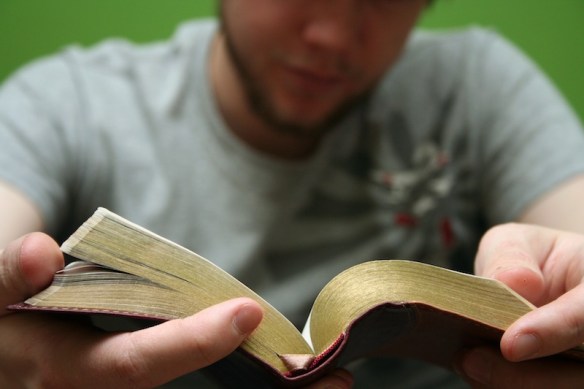
Young man reading small Bible


To learn to fast, try skipping one meal. In the time you would have spent eating, read the Bible and pray. Feed your soul. Remember, fasting is not dieting. Fasting is a spiritual discipline that accompanies prayer. Prayer is often mentioned in Scripture without fasting but fasting in Scripture is almost never mentioned apart from prayer.

After you’ve made it through one meal, the next week build up to missing two meals so you can pray, read more of the word, and worship. Soon, you will learn how to spend an entire day fasting and it will seem easier as you do it more.

If you will drink plenty of water while you’re fasting it helps curb the appetite and of course will keep you feeling more refreshed. Avoid sugar drinks but 100% fruit or vegetable juice in moderation will help sustain you during longer fasts. You will be surprised how energetic and alert you will feel as you fast and pray.

God’s Word will spring to life in your mind and spirit as you read chapter after chapter, all the while seeking God’s face when fasting. Prayer will seem more spontaneous and faith will rise up inside you.

If you have to follow a medical diet you should check with your doctor before attempting a long fast. If you must eat something in order to take daily medications, or for some other reason, you might consider a type of “Daniel fast”. He fasted from only certain rich, tasty foods and lived on a small controlled diet for a few weeks. If you must eat for medical reasons, could you do a “fruit fast” one day where all you eat is a small amount of fresh fruit? Because our bodies are so accustomed to large portions and variety, you can still get the benefits of fasting even if you ate an apple instead of a large meal. 

No matter how you approach the fast, the key is Bible reading with prayer. Try fasting and as you discipline your body you will discover a deeper walk with God and more faith in your prayers! You can do it.

~JKB

PRAYER MEETINGS CHANGE THE WORLD

JKBcirclePRAYER MEETINGS CHANGE THE WORLD!
I’m unapologetically committed to prayer meetings because they change the world! For instance, the Holy Spirit was poured out at Pentecost, in direct response to the promise of God, and the 10 day prayer meeting held by the church in the upper room. “All these with one accord were devoting themselves to prayer, together with the women and Mary the mother of Jesus, and his brothers.” (Acts 1:14)

There are more than 500 direct references to prayer in the Bible, so obviously I believe in prayer meetings because they are Scriptural. God says prayer meetings are important!

Prayer meetings have also shaped the history of the church. The Moravians, for instance, held an unceasing prayer meeting that lasted 24 hours a day for 100 years. That prayer meeting launched the modern mission movement, broke the back of the evil of the slave trade in England, and led John Wesley to Christ. Wesley, in turn, helped ignite the Evangelical Awakening in Great Britain, and influenced the Great Awakening in the 13 American Colonies. The results of the 100 year prayer meeting touch almost every aspect of evangelical history

In the 19th century, the Fulton Street Prayer Meeting, also known as “the Great Prayer Revival,” in New York City spread prayer meetings across the United States between 1857-1858. More people came to Christ, per capita, during the Great Prayer Revival, than at any other period in US history before or since.

In addition, the Prayer Revival helped unify the nation enough to elect a President from a new, anti-establishment, anti-slavery political party. The political party, now called the “GOP”, was only 6 years old in 1860, when the “outsider” candidate, Abraham Lincoln, became the first Republican President. In that sense, the prayer meeting paved the way for the election of Lincoln and thus, the abolition of slavery in America. Obviously, prayer meetings have shaped history.

I also believe in prayer meetings because I’ve experienced their power first hand. From my college days, and the nearly all night prayer meetings that helped fashion my ministry, to the city wide prayer meetings in Austin, Texas that have led to increased unity in the Body of Christ and changed the weather patterns in Central Texas, I’ve witnessed God answer prayer.

Recently, I saw God’s protective power as a result of a prayer meeting. I was invited to preach at Promiseland Church in Austin where my friend, Bishop Kenneth Phillips is the pastor. Unbeknown to any of us, a disruptive group of young men had planned to interrupt our service that night. The leader was dressed as if he was headed to a masquerade ball garbed as an Old Testament prophet. Some of the men wore military style fatigues, and one carried a sign. They were a bizarre gang.

As I started to speak, the weird gaggle entered the worship center walking confidently toward me, shouting out to the congregation and to me, demanding to be heard. I can imagine numerous ways that scene could have played out badly but it didn’t. Those disruptive young men hadn’t calculated on what happens when chaos meets the superior force of a church anointed by the power of prayer. Promiseland Church had just concluded an intense period of seeking God through 40 days of prayer and fasting.

As soon as the trouble makers came in, noisily interrupting the service, the staff and others from the church immediately surrounded them and quickly escorted them out without incident while the rest of us entered spontaneously into a brief season of uplifting praise and prayer. 

The presence of the disruptive group and the church’s response to them was only a small part of the clear hand of God on the church that night. The Spirit of the Lord was manifestly conspicuous in every moment of the service. I don’t know to describe the sensation, except to testify with an imperfect analogy; the presence of the Lord was “thick” in the atmosphere.

A powerful prayer meeting produces that kind of indescribable experience, and leads to clear manifestations of answered prayer. If we want to see God move with power in our churches, our cities, and our nation, believers must gather frequently to pray. Prayer meetings change the world!

-jkb

THE IMPORTANCE OF SPIRITUAL GIFTS IN A HEALTHY CHURCH

JKBcircleTHE IMPORTANCE OF SPIRITUAL GIFTS IN A HEALTHY CHURCH

Last Sunday I preached a message on spiritual gifts. Below you will find an expanded sermon outline combining both the morning message and further thoughts delivered at The Quarries Church 5pm service. Also, I have included the link to watch the morning message.

Since the subject of spiritual gifts is so important to the healthy life of the church, and since a single message only provides an introduction to the subject, I am teaching on the subject of spiritual gifts beginning this Wednesday evening (August 12, 2015) at 6pm in Friendship Hall at Hyde Park Baptist Church.

THE SPIRIT EQUIPS THE CHURCH
(1Corinthians 12:4-7)
Karl Vaters: “Spiritual gifts can’t be learned or earned. They’re given.”

2 Clarifying Questions:

1) WHAT ARE SPIRITUAL GIFTS?
(v.4) -“gifts” is the Greek word, “charisma” from root “charis” which is translated, “grace.”
Literal translation: “An unearned favor,” “a gift of grace”
(In this context the word means “Gifts of the Spirit”)
In modern Greek the word “charisma” means
“birthday presents”

The four New Testament passages where spiritual gifts are listed:

-Romans 12:6-8
-1Corinthians 12-14
-Ephesians 4:11-12
-1 Peter 4:10-11

2) DO SPIRITUAL GIFTS MAKE A DIFFERENCE?
YES!
(v.6) “and there are varieties of activities, but it is the same God who empowers them all in everyone.”
“activities”
“empowers”
These two English words are the same word in Greek: “energeo” (From which we get the English word “energy”).
The literal translation of energeo is: “To work, to be effective, to use power, to be active, to be operational.”

Spiritual gifts make a difference because they are the tools the Holy Spirit gives us to live the Christian life while we serve and proclaim Christ in the world! SPIRITUAL GIFTS ARE ACTIVE-THEY DO SOMETHING!

♦️THE SPIRIT EQUIPS THE CHURCH WITH A DIVERSITY OF GIFTS (vv.4-6)

John Piper: “Different Christians have different spiritual powers given to them by the Holy Spirit.

The Greek word translated “varieties” only occurs 3 times in the New Testament- in vv. 4-6! Even believers with the same gift will express it differently and there may be nearly endless combinations of predominant and secondary gift mixes. While it is true every believer has at least one gift, it is probable that we all have a combination of gifts.

♦️THE SPIRIT EQUIPS THE CHURCH WITH A DEMONSTRATION OF GIFTS (v.7)

Charles Stanley: “When a believer exercises her gift, it is an exhibition of the Spirit’s power through her. It is not simply a matter of doing something she is good at. Spiritual gifts are a manifestation of the Holy Spirit.”

The Greek word translated, “manifestation” comes from a root word (“phos”) which means “light” (we get the words “photograph” and “phosphorus” from it). In this case it means our spiritual gifts make the invisible Holy Spirit “visible”- our gifts “manifest” the Holy Spirit!

The purpose of spiritual gifts is clear from the phrase “…for the common good” (v.7). When we use our spiritual gifts in ministry it is not only a deeply satisfying experience for us it is the way we best serve the rest of the Body of Christ.

~jkb

PREACHING OUT OF SEASON

JKBcirclePREACHING OUT OF SEASON

One night years ago, in the first months after I had surrendered to ministry, I dreamed I was preaching to a large crowd and they all turned around and walked away. When I told my pastor the next day he laughed and said, “Every preacher has had that dream.” Obviously, preachers want to have their message heard but what if people stop listening?

There will always be faithful Christians who want to hear biblical teaching but Paul cautioned that a day would come when masses of people (if they attend a church service at all), will only listen to what they want to hear. Rather than gathering to hear a word from God (regardless of how personally confrontational that truth may be to their lifestyles), a group will emerge who will choose their preachers based solely on what they desire to hear. In other words, their eager teachers will effortlessly reinforce the ideas the hearers already wished were true. Instead of adhering to biblical teaching, popular religious preference will morph into an eclectic playlist of politically acceptable philosophy, culturally common sentimentality, shared outrage at the hint of anything confrontational, with a few old Christian terms and forms to make it all feel familiar. The culturally acceptable religion of that scenario may use our vocabulary but it will definitely not use our dictionary.

Most biblical preachers have experienced those moments when, while being faithful in the delivery of biblical truth, the congregation grows irritated by what the speaker is saying. Those times are expected and can be the beginning of deeper spiritual growth as believers are confronted with truth. According to the Apostle Paul, however, a movement resisting and ignoring biblical truth will become the norm and there will be no shortage of teachers willing to accommodate the trend (2 Tim 4:3). What should preachers do when they find themselves in that environment?

Some voices today advise preachers to merely change the methods of communication (http://wwv.group.com/refresh-the-church/blog/monologue-or-dialogue/#.VZbkPFI8KJL). In the “Information Age” when facts of all kinds are as close as your smartphone, some argue that Americans don’t listen or process information the way we once did. No doubt there is some truth in that observation. Excellent communicators, therefore, consistently work from the premise: “If I am not connecting with my listeners, I need to improve.” Most of us, for instance, remember Professor Howard Hendricks chided preachers with the admonition, “It’s a sin to bore people with the Bible.”

Methods of communication can change. Effective preaching and teaching styles often vary while remaining faithful to the significant ministry preachers and teachers are called to perform. Paul warned against something worse, however, than a dry delivery. He cautioned preaching itself would go “out of season” (2 Tim. 4:2). In that case, the issue is not style- it’s substance-because Paul instructs us to “preach the Word” when the Word is “in season” and popular, or even when it is “out of season. stop_your_preaching-57485

Is it possible that our culture has decided it has heard enough Biblical preaching? Perhaps. Church attendance in America is stagnant or declining according to most polls and atheism is growing. Stronger opposition to historic biblical interpretation is being called into question more candidly than ever. Recently, for instance, a Presidential candidate announced that religious views needed to change to accommodate a political view held by many Americans ( http://www.nationalreview.com/article/417448/hillary-clinton-religious-beliefs-have-be-changed-accommodate-abortion-joel-gehrke). Did Mrs. Clinton mean religious people who differ with her should thoughtfully change on their own, or, was she implying that under her potential administration the law could force that change? It’s hard to imagine the latter but forced ideology by governmental regulation is not without precedent. Recently a baker who lost a law suit due to her refusal to bake a cake for a same sex wedding had an “effective gag order” placed on her by the court, insisting she stop speaking about her religious objections to same sex marriage (http://dailysignal.com/2015/07/02/state-silences-bakers-who-refused-to-make-cake-for-lesbian-couple-fines-them-135k/). What do Secretary Clinton’s comments have to do with the cake baking issue? It seems both new and strange that a powerful political figure, during an election cycle, would appear to suggest that politics could enforce the religious beliefs of fellow Americans. Yet, we have observed a few recent examples -such as the baker in the same sex wedding cake law suit, who has told by an American court she can’t speak about her religious views. Both situations appear to be government intrusions into the religious freedoms of Americans. Are pastors like me being too sensitive or is there a shift taking place in American culture?

After the last round of Supreme Court decisions it felt like the worldview I hold was handed a ribbon for second place in the culture wars. The social changes rapidly occurring in the United States, however, are objectively more than the subjective concerns of a few pastors. In the decision on same sex marriage, for instance, Chief Justice Roberts ominously observed, “Unfortunately, people of faith can take no comfort in the treatment they receive from the majority today.” (http://www.washingtonpost.com/news/acts-of-faith/wp/2015/06/26/here-are-the-key-excerpts-on-religious-liberty-from-the-supreme-courts-decision-on-gay-marriage/)

In the early days of the Church it was much worse. When Stephen, one of the leaders of the original Jerusalem church, was called to defend his faith, he boldly preached one of the greatest extemporaneous sermons in history. The assembled crowd listening to him, however, viewed the sermon differently- they skipped past the invitation hymn and rushed straight to the benediction – and killed Stephen for what he said. Nestled in the emotional chaos of the mob scene that led to Stephen’s violent murder, is a phrase I have paid little attention to until lately. “But they cried out with a loud voice and stopped their ears and rushed together at him.” (Acts 7:57) Before they assassinated the first Martyr of the Church, they “stopped their ears.” In other words, they had heard enough. Could that happen again? As the division and polarization of American society becomes more emboldened by louder voices on all sides will we reach a tipping point when huge segments of culture simply stop listening to the message being preached in our churches? Will they conclude they’ve heard enough? Or, has that happened already?rejected-1

Preachers should prepare to spend the next phase of their lives “out of season.” Fortunately, societal rejection often clarifies the resolve of the church, and history is replete with examples of history making renewals of the church in the face of persecution. When Stephen was killed, for instance, the message of the gospel quickly spread outside of Israel as a result, so that within a generation it had reached the farthest reaches of the Roman Empire. Centuries later when Wesley and Whitefield were forced out of the Anglican pulpits their open air sermons spread the evangelical message to the English speaking world and fueled a Great Awakening. In the early 20th century, when Mao forced missionaries out of China the Chinese Christians went “underground” and the Christian Church grew exponentially. A similar movement occurred in Communist Romania. The totalitarian government tried to destroy Christianity but Christians are resilient. Today in Romania Christianity is alive and communism is gone. Ironically, persecution has often strengthened the Church.

I predict the same kind of renewal will occur in a new generation of fearless young American preachers- unaccustomed to being in the majority and unintimidated by the majority. American culture has changed and continues to change and when persecution of any kind comes against the Church, the outcome could be revival, led by faithful preachers.

The current cultural climate may encourage sincere and concerned churches to consider insightful new methods to express the biblical message, while simultaneously other congregations will echo the views of the secular majority, thus surrendering any prophetic voice. In the midst of the upheaval, however, a counterintuitive and surprisingly contemporaneous power persists in the ancient instruction: “Preach the Word.”open-bible ~jkb

“…preach the word; be ready in season and out of season; reprove, rebuke, and exhort, with complete patience and teaching.” (2 Timothy 4:2)

PASTORS PRAYER GATHERING

JKBcircleWe are in a unique moment in Austin,Texas. I don’t want to miss out on what God is doing and what He wants to keep doing. Some of my brothers in the ministry have been laboring for years to see the Austin prayer movement gain spiritual momentum and I believe we are seeing the fruits of their labor.

Something unprecedented occurs when prayer warriors who are accustomed to powerful, private prayer join together and cry out to God. Scripture (and well documented Christian history), reveals what God does when the people of God pray together. It can be a game changer for everyone involved!

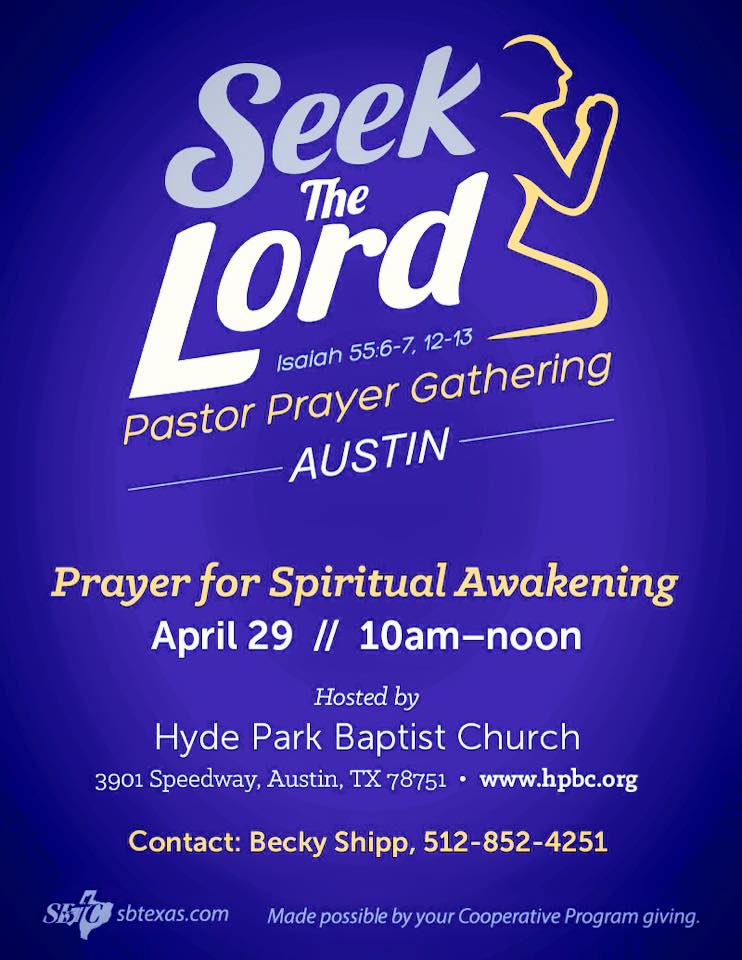
That’s why I’m asking you to join with me as Austin pastors and leaders gather for passionate prayer on Wednesday, April 29 at Hyde Park Baptist Church. Please lift that event to God in prayer as you are with other Christian leaders in the next week or so. Please use your social media to let other pastors know that we will be praying together. Please join us from 10am – noon. Come when you can- leave when you must, but please come. 10478208_10206717179155106_3760880474126452763_n

Fortunately, what God is doing in Austin is part of a larger movement across the country. Last month, for instance, I was privileged to serve on a panel discussion in Albuquerque, New Mexico with six or seven other ministry leaders. Our topic was evangelism. One of the other panelists was from San Antonio where God is using his church as a House of Prayer. The testimonies he shared about what God is doing through prayer excited my spirit. Another pastor, who served on the panel, leads a day and night prayer ministry in Las Vegas where he is seeing a genuine move of God. When I spoke, I shared with the 200-250 pastors who attended the panel discussion about the prayer movement in Austin. I sensed a hunger across the room as I challenged those pastors to go back to their cities and join with a few other pastors in persistent, passionate prayer. 20131104-084359.jpg

I believe it is possible God is raising up some key cities across the country where revival is most improbable in the flesh, and most likely in the Spirit! In those cities pastors are already gathering in large, unprecedented numbers to pray. Obviously, we believe Austin is an epicenter for the prayer movement and revival. I want to do everything I can to encourage prayer in my church and across our city. Will you join me? The time is now. 

“And when they had prayed, the place in which they were gathered together was shaken, and they were all filled with the Holy Spirit and continued to speak the word of God with boldness.”
(Acts 4:31)

FOR MORE INFORMATION ABOUT THE CITY WIDE PASTORS PRAYER GATHERING GO TO HPBC.ORG OR CALL MY EXECUTIVE ASSISTANT “BECKY” AT 512-459-6587

-jkb

WHAT JESUS PRAYS FOR YOU

JKBcircleWHAT JESUS PRAYS FOR YOU
(John 17:14-18)

HOW POWERFUL ARE THE WORDS, “I’m praying for you”?

They can mean a lot- especially if you believe the person saying those words knows how to pray! One day Jim Cymbala, the pastor of Brooklyn Tabernacle called me to pray for my wife who was facing serious surgery. That call was a real encouragement because I know Pastor Cymbala is a man of prayer. A pastor’s prayers can mean a lot but as believers we have Someone greater than pastors or teachers praying for us. Jesus Himself is praying for His people!

Robert Murray M’Cheyne, the Scottish preacher once said, “If I could hear Christ praying for me in the next room, I would not fear a million enemies. Yet distance makes no difference. He is praying for me.”

If you are a follower of Christ you can be sure Jesus is praying for you. The question is, What is He praying for you about?

•JESUS PRAYS FOR YOUR SPIRITUAL PROTECTION
(vv.14-16)

You have an enemy! Jesus called him “the evil one” (v.15). Someone recently said, “The devil is preying on me, but Jesus is praying for me!” True.
Jesus left the Church in a battle behind enemy lines and therefore He prays to keep us safe from the enemy!

•JESUS PRAYS FOR YOUR SPIRITUAL PURITY (v.17)  jesus-prayer-09

Jerry Bridges wrote, “God has not called us to be like those around us. He has called us to be like himself. Holiness is nothing less than conformity to the character of God.”

Holiness sounds like a word from the Christian past instead of a description of God’s people today. Yet, Jesus prays that you will be sanctified- a word that means “set apart for God’s holy purposes.” How can that spiritual cleansing occur? Jesus said it happens as we immerse ourselves in the Word of God (v.17).

•JESUS PRAYS FOR YOUR SPIRITUAL PURPOSE (v.18)

The California pastor and author Francis Chan recently made a poignant observation. He said, “The point of your life is to point to Him.” The church is on mission with God. We are sent into the world to reach a lost world and proclaim our Lord’s message of grace!

If Jesus is praying like this for you, what are you going to do now? Respond in faith and rise up to be the person prays you will become! Amen.
~jkb
WATCH THE SERMON HERE https://youtu.be/Yx2dW3jZZCs

WHY I PREACH THE BIBLE

JKBcircleWHY I PREACH THE BIBLE
There’s an old saying among evangelicals that I believe is true. “Where Scripture speaks, God speaks.” God has chosen to reveal Himself through His written word- which in itself tells us something. Among other things, it reminds us truth is objective and outside of us. God chose to reveal Himself through language which can convey thought more clearly than any other expression. Language can be used subjectively, but it is objective because it is outside of our experience and can be tested by  the insights and wisdom of others. It’s how we reach agreement with other people-we discuss ideas until we find consensus even at the level of the most intricate details. Only language allows us that depth of precision in relationship with other people. Words are powerful.

When describing Himself, God is satisfied to be described not only as the “God of the Word” but also as the “Word of God” (John 1:1)! When we worship the God who calls Himself “the Word,” that description itself suggests a lot about the best way to talk about God. We can conclude that He is best described through language. Acts of service, visual artistry, musical masterpieces, a warm smile, a welcome embrace, the beauty of an ocean coastline, and other non-verbal forms of communication all play their own significant part in explaining who God is- but the best way to talk about God is to talk (or write) in as clear and precise a way as possible.

That is why I believe in biblical preaching. God uses preaching. Paul, for instance, knew that the word on the street in the ancient Greco-Roman culture dismissed the preaching of the gospel as unsophisticated and “foolish.” He responded to that characterization by being direct and serious but also somewhat facetious. He said, “For since, in the wisdom of God, the world did not know God through wisdom, it pleased God through the folly of what we preach to save those who believe.” Paul didn’t think his message or his preaching was foolish. He was gouging his critics with their own words. He was suggesting, with a subtle humor, that preaching may be “foolish,” but that “foolishness” was spreading like wildfire and changing lives by the thousands across the “sophisticated” Roman Empire!

open-bibleI am privileged to preach every week and I have witnessed first hand how the explanation of Scripture can shape ideas, affect moral decisions, and change hearts and minds in dramatic ways. I concluded long ago that the preaching of Scripture has a power to do what no other force can do. It still amazes me every time. Preaching can connect people to God by building faith and by convincing hardened hearts to turn to God (Acts 2:36-37; Romans 10:17).

That’s why I preach. God uses the preaching and teaching of the Bible to change people’s lives-sometimes gradually and sometimes suddenly! If I had my choice of lives I would still choose the one God gave me. I am a Bible preacher. No matter what may change in the culture around me, one conviction remains steady. “Where Scripture speaks, God speaks.”
~jkb

THE POWER OF CONVERGENCE IN PRAYER (how God connects seemingly unrelated prayers)

JKBcircleTHE POWER OF CONVERGENCE IN PRAYER
(How God Connects Seemingly Unrelated Prayers)

In my home state, a hundred miles or so from the city life of Fairbanks, there are two rivers as different as two could be. One is silty, muddy, and thick from natural debris. It is the color of sand because it consists of tons of it. It is a fast running river with a heavy current which can be dangerous if not respected. The other river is clear and potable (at least it was when I was a boy). We drank from it without fear and we always believed it was the best water we had ever tasted. It was cold and flowed in the warmer months from the melting snow cascading in torrents from the high hills and mountain peaks surrounding it. My Dad, my uncle, and the rough Alaskan “old timers” I knew then revered that river as if it was the best place on earth. Even the name was inviting. It was called “The Goodpasture.” My dad and his brother spoke of it as if was their favorite place. Every year, a trip “up the Goodpasture” was the high light of our summer as often as we could steal away. I have a thousand good memories of “running the river” up the Goodpasture.

Getting there wasn’t easy. First we drove almost 100 miles to the boat landing. The first several miles in the boat consisted of fighting the constant current on the silty, muddy, swirling waters of the Tanana River. Then, around a bend in the muddy river, the “convergence” occured. The meandering flow of the Goodpasture emptied into the Tanana and for at least a few yards the clear water was obvious before it was swallowed up by the silty, swift and overwhelming power of the Tanana. But for a brief time the two rivers nearly formed a third distinct body of water-neither completely muddy nor completely clear. It was a convergence of the two, distinct from either of the other.

I mention all of this because if it weren’t for that intersection of two different rivers they would have little in common. The choppy waters of the Tanana aren’t easy to travel but if you want to get to the rustic but welcome cabins along the Goodpasture, that convergence is essential- it is the way you go up the Goodpasture. As far as I know, it’s the only way- it certainly was the only way we ever got there.

CONVERGENCES OF CIRCUMSTANCES OUTSIDE YOUR CONTROL

In other examples, in apparently unconnected aspects of life, convergences sometimes occur in the unexpected connections between seemingly unrelated people. For instance, when God prepares to move in power He often aligns previously independent forces. That’s what happened in the well known story of David Wilkerson’s life.

Many people are familiar with the broad outline of what happened nearly 60 years ago when Rev. Wilkerson went to New York City to help Gang members. The rural pastor had grown frustrated with his life and ministry, and had begun retreating to his prayer room for hours each night crying out to God.

The story has often been repeated about the night he saw a Life Magazine cover that caught his eye- it pictured several boys on trial for murder in New York City. The sight was the impetus for Wilkerson’s decision to go to New York in response to what he perceived to be a calling from God. Once he arrived the events that unfolded became the basis of the international Bestseller, “The Cross and the Switchblade.”

So far, that story is well known. What might not be so well known are the details involved in the convergence of God’s plan in a seemingly unrelated series of events taking place at the same time. While David Wilkerson, (the then unknown country preacher from rural Pennsylvania) was growing restless and frustrated with his life and sensing a growing burden to spend his evenings in prayer, unbeknownst to him, in New York City, a journalist living and working among the wealthy and erudite intellectual elite in Upper Manhattan, named John Sherrill, though only nominally Christian, had become uncharacteristically burdened over the moral and social decay of the city. He was privately, persistently praying for miracles. Meanwhile, a third strand of a growing convergence was being woven into the heart of an intense young man with a growing reputation as a prayer warrior. Dick Simmons was a Christian Bible-college student across town who had recently been gripped by a new burden to intercede for the city. He was regularly crying out to God for somebody to be raised up, by God’s power, to reach the gangs and restless youth of the inner city. One night he went down to the woods by the Hudson River and prayed for hours. His loud prayers even brought the police out to investigate what was going on. He told the officers he was praying for God to send laborers into the harvest of the city. The police didn’t know what to think of that, so they left him there praying.

HOW THE HOLY SPIRIT CREATES CONVERGENCE

The Holy Spirit was creating a convergence of circumstances- made up of disconnected lives about to be united in God’s heart for the city. They were three men-strangers to each other- with only one thing in common. The country preacher from Pennsylvania, the Manhattan journalist, and the intercessor in Bible College, all had an urgent burden for prayer and they all knew it would take a miracle to reach the New York City gangs. The miracle, they were soon to learn, was on the way. For instance, the very night the police found Dick Simmons praying for laborers in the woods by the Hudson, David Wilkerson, at that very moment, was barreling through the darkness toward New York City unshakably convinced God had instructed him to go help gang members. God was orchestrating a convergence.

How did those three praying men converge? John Sherrill, the Manhattan journalist, met David after the preacher made local news in New York while trying to minister to gang members. A few years later, Sherrill helped Wilkerson chronicle his experiences in The Cross and the Switchblade, a book published in 1963 which has never gone out of print, and which became one of the most influential Christian books of the 20th century. Dick Simmons, the Bible college student with a burden for laborers in the harvest, later met David Wilkerson and under the minister’s visionary guidance, helped Wilkerson start Teen Challenge, one of the most effective drug treatment ministries in the world. God brought the three men together and used them, in a sense, as a part of the answer to their own prayers!

DOES GOD REPEAT HIMSELF?

Can God do it again? Of course. He is doing it all the time. He is doing it now. If you pray and seek His face, and passionately believe and don’t give up, He will probably involve you in His converging plans to reach people in our world today. Imagine the faith it builds in you when you know that even “impossible” circumstances are possible because God is always working behind the scenes to create unexpected breakthrough. And when you think you’re alone, consider the times someone else felt alone but then “miraculously” met others with the same burdens and hunger for God. Do you remember the story of the prophet Elijah? He repeatedly insisted he was the last of the prophets (1 Kings 18-19). It was only when Elijah was nearly too discouraged to go on that God assured the lonely, discouraged prophet He still had “7000 who hadn’t bowed the knee to Baal” (1 Kings 19:18). Following that promise God introduced a convergence-the young prophet Elisha– a man with a kindred spirit! Vintage_Puzzle_by_Fel1x

If you are praying for your family, your school, your church, city, or nation, you are not alone. God is building a convergence in the burdened hearts of praying people everywhere. Keep praying and expect the unexpected. It’s how God works! God may be preparing a team of wise, praying friends to join with your own intercessions and pleading prayers. You should be on the look out for them. The streams of God’s love are flooding into a thousand other hearts, like tributaries rolling down from hills of mercy. Be ready. Someone you least expect right now may part of the answers to your prayers. There may be a clear river of blessing ready to converge with your faith and prayers at any time. God is already at work. He’s waiting for you to join Him.

~jkb