Raise your hand if you like to be criticized. I don’t expect any takers for that offer! Nobody, with a normal emotional outlook, likes to be criticized. But since no one escapes it, all of us should have a “game plan” for handling it.
Leo has a laptop but no where in particular to plug it in. He’s homeless on the streets of New York City. Patrick McConlogue, a computer programmer, passed Leo everyday on his way to work and one day decided to make Leo an offer. He would give him $100.00 cash or teach him to write computer code. Leo chose to learn. According to Relevant Magazine, Patrick gave Leo 3 books on coding, an inexpensive laptop, access to an online training site, and 16 weeks of personal computer lessons. This week, Leo released his first app for $.99 which helps commuters find other drivers who might want to carpool along their route to work. Leo is now a computer coder- he made the right choice!
I once heard a preacher say, “A conviction is not a belief you hold, a conviction is a belief that holds you!” How true. In some ways our culture is dividing itself into politically polarized camps of people with extreme views on almost every issue with an unwillingness to bend. In another, and perhaps broader and more heavily populated corner of culture, however, Americans seem uncertain and unclear about things that only a few years ago were held as unquestioned assumptions by the majority.
For Christians, the pressure to moderate our unique views, which we believe are taken from Scripture, is constant. The none too subtle message today seems to be “go along to get along.” For newer believers, it often appears to be social or career suicide to hold onto biblical convictions too tightly, because the times are rapidly changing and those who hold to opposing views are more readily outspoken than ever before.
Yet, the pressure to conform is nothing new and only serves to highlight why we need convictions in the first place. Without them, we tend to drift, and when we do, we can lose the moral high ground of a distinctly Christian worldview. That’s a costly loss for the Christian and for culture. Deliberately choosing to mute our own perspective, no matter how unpopular, in order to blend into the popular trends of the moment, will rarely benefit anyone for long. After all, it is assumed that we will almost always be on the opposite side of the debate in a non-Christian world. No wonder Paul advised the Corinthian Christians, in the midst of their clear minority status, to be “…steadfast, immovable, always abounding in the work of the Lord, knowing that in the Lord your labor is not in vain” (I Corinthians 15:58). In other words, it eventually pays off to take the right stand.
A glance at the most current headlines illustrates the point that while it is often costly in the short run to stand on conviction, it could turn out to be rewarded in the long run.
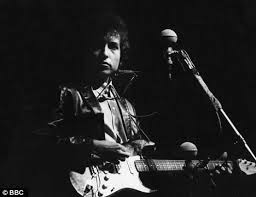
For instance, when Bob Dylan decided in 1965 to use electric instruments at a Folk Festival he was nearly booed off the stage. One festival organizer, Pete Seeger, even threatened to use an ax to chop up the cable leading to Dylan’s amplifiers! The folk music purists there that day, and at subsequent concerts, shouted their displeasure and hurled insults like “traitor” and “Judas.” Footage from those concerts is brutal to watch. Yet, Dylan was undeterred. At one point, as fans in England turned on him for playing an electric guitar, Dylan shouted back, “I don’t believe you!” The certainty in his own mind that he was doing the right thing convinced him, apparently, that the angry fans were not being honest with themselves when they booed and demanded he stop. So he continued to play his electric guitar.
And that electric guitar- a 1964 Fender Stratocaster- serves to illustrate how remarkably rewarding standing by one’s convictions can be. Last Friday, December 6, 2013 Dylan’s Stratocaster, the very one he first played, which was once heckled and reviled, sold for almost $1 million dollars at an Auction in New York. Bob Dylan was widely criticized for his conviction years ago to play that guitar. Today, that insistent (and perhaps stubborn) refusal to back down, along with the Stratocaster itself, is part of Rock music legend, and his decision to “go electric,” according to Rolling Stone Magazine, is one of the most notable events in music history.
Your convictions probably won’t garner so much attention, but if history proves anything it is that convictions have a way of turning opponents into supporters, and the things we pay a price to believe today may be rewarded tomorrow! So hang in there when you are doing the right thing regardless of the apparent unpopularity of the moment. After all, “the times, they are a changing,” but you can remain steadfast in your convictions!
-jkb
We’ve all heard the amusing and ironic saying, “Lord, give me patience and give it to me now!” And yet, no one really believes it works that way since patience has never been instant. Instead, it apparently takes a lifetime to develop, and I wonder if some of us ever master the art of waiting.Can fear distort your perception? Yes. Anyone who has ever been alone at night knows a creaking house seems louder and more concerning in the dark than it does the next day. But beyond the personal experiences of having been startled in the dark, research conducted recently proves fear changes the way we perceive reality.
In 2008 researchers performed an experiment at the top of a hill, using a skateboard, a short box, and multiple participants unaware of the nature of the test. One group was asked to stand at the top of the hill on a short box the same height as a skateboard. The other group was asked to stand on the skateboard (which had been secured so it wouldn’t roll). Both sets of volunteers were asked to judge the distance to the bottom of the hill. Without exception the participants who stood on the skateboard estimated the hill to be much more steep and further to the bottom. The research team concluded the people standing on the skateboard had a natural since of danger, and thus their perception was affected by fear.
In a similar series of experiments in 2012, an Emory University psychologist teamed with a colleague from the University of London and found reaction time to approaching objects was measurably different when fear is a factor. People were shown various objects on a computer screen, simulated to seem as if they were moving toward them. They were instructed to push a button at the point they would naturally duck or dodge the object if it were actually coming at them. Whenever the image shown was a snake or large spider, two things most people naturally fear, people responded much sooner. These repeated findings led the psychologists to conclude that people perceive frightening objects closer than they are when thrown toward them. In other words, fear fakes us out!
Scripture teaches the same lesson. When the young shepherd David arrived to the battle between Israel and the Philistines, Goliath had already issued the challenge to fight for 40 days. There was no battle, however, because everyone in the Israeli army (including David’s older brother, Eliab) was “terrified” by the giant (1 Samuel 17:11). When David challenged the men about their unwillingness to fight, Eliab interrupted in an attempt to demoralize and silence David. Eliab chided David that he had only tended to sheep and therefore had nothing to base his confidence on regarding fighting the giant (v.28). Eliab, in his anger, sibling rivalry, pride, and fear saw tending sheep as a liability.
On the other hand, when David went before King Saul, confidently assuring the King that David would rid the Israelites of their enemy, the sheep were his proof- they were “exhibit A” in David’s argument.
The Scripture tells us, “Saul replied, “You are not able to go out against this Philistine and fight him; you are only a young man, and he has been a warrior from his youth.”’
“But David said to Saul, “Your servant has been keeping his father’s sheep. When a lion or a bear came and carried off a sheep from the flock, I went after it, struck it and rescued the sheep from its mouth. When it turned on me, I seized it by its hair, struck it and killed it. Your servant has killed both the lion and the bear; this uncircumcised Philistine will be like one of them…'” (1 Samuel 17:33-36).
Eliab was filled with fear and thought the sheep were meaningless. David was filled with faith and concluded the sheep were proof of his readiness for battle. Fear misses what faith sees!
When you have to face the big challenges of your life you will always have one of two choices- fear or faith. Fear blinds you and makes your problems seem bigger than they are, while faith gives you eyes to see things as God sees them! To conquer fear you should gaze at God and glance at your problems. The more you focus on Him, the more you realize just how great our God is! The problems that frighten you are minuscule compared to God’s power. Faith sees the resources at your disposal that fear overlooks every time.
-jkb
Faith Calls Us to Action!
.
To begin His ministry, Jesus retreated to the desert of Judea for 40 days of fasting. While we might not fast for 40 days, it is clear the Lord Himself models the importance of fasting. Since Jesus fasted, shouldn’t we?
In addition to practicing the fast, Jesus taught His disciples how to fast and said, “When you fast….” He did not say,”If you fast (Matthew 6:16). He anticipated that we would fast in the same way He anticipated that we would pray (Matthew 6:6). No believer would doubt the necessity of prayer, and neither should we discourage the significance of fasting.
In addition to these examples, Jesus affirmed His belief in the importance of fasting when, concerning His followers He said, “The time will come when the bridegroom will be taken from them; then they will fast (Matthew 9:15). Notice He said, “…they will fast.” That time, when the Bridegroom is taken away, is now. Therefore, the time for fasting is now. The fact that Jesus practiced and taught the importance of fasting is reason enough for many of us, but are there additional reasons for fasting? In other words, why do we fast?
Ron Dunn once said, “Fasting detaches us from earth and prayer attaches us to Heaven!” Throughout Scripture godly men sought God through fasting and prayer. Moses, Elijah, Daniel, and Ezra are prime Old Testament examples of men who fasted and prayed before experiencing significant spiritual victories (Ex.34:28-29; 1Kings 9:7-8; Da.10:2-3; Ezra 8:21-23). Their examples offer us additional biblical justifications for fasting.
Moses retreated for prayer and fasting before receiving the 10 Commandments. Daniel fasted when he was burdened about understanding a prophetic vision. Ezra called an urgent public fast to seek God’s protection and Joel called a nation to fast during a season of national repentance (Joel 2:12).
Each of these instances highlights the sense of spiritual intensity associated with fasting. These men fasted because their desperate circumstances were hopeless without God’s immediate presence. They were more hungry for the power of God than for their next meal.
When the stakes of life and ministry are high, the child of God should fast! When united with prayer, fasting stokes the flames of our spiritual desire, and focuses our attention on the things of God with a searing intensity. God seems to focus on those who focus on Him! So, when you need to fire up the power of your prayer life, you should fast!
-jkb
Have you heard the old expression, “Where there’s smoke, there’s fire”? In other words, when you see examples of one thing, it often points, or draws attention, to something else. In the case of smoke and fire, the lesser thing – smoke-alerts us to the greater thing-fire. The same may be said about prayer. When we find numerous examples of praying people and congregations we can conclude that the prayer itself is not the end in itself, rather it is pointing to something greater. In the case of prayer that greater thing is God Himself- the one to whom our prayers are directed and the one who powerfully answers our collective and personal cries. That is one reason the growing chorus of prayers around the world are so important. They are a leading indicator that God is preparing His people for something big.
Examples of the worldwide prayer movement are not isolated. In fact, they are growing more common. The results vary, but the passionate commitment to ceaseless prayer is a common thread in the tapestry of the prayer movement. In the little town of Jefferson, Oregon, for instance, a church of 25 people and a disillusioned pastor came nearly to the end of their hope of ever making a significant impact on their city. But, after attending a conference on prayer where his own faith was strengthened, the reinvigorated pastor led his church to make prayer the main business of their church. The pastor led the way, by personally spending about 2 hours a day in prayer everyday, and by frequently teaching his people the truths he was learning. Today, just a few years later, the little Jefferson Baptist Church now welcomes 1400 people a week in worship services, in a town of only 2,000 people! The church motto is: “Much prayer, much blessing; little prayer, little blessing; no prayer, no blessing.” The power of congregational prayer literally changed the church and increased its witness far beyond the imaginations of everyone involved.
Years earlier, on the other side of the nation, the mid 1970’s were witnessing the struggles of Jim and Carol Cymbala as they hoped to keep their ministry in Brooklyn from folding under the pressure of their surroundings. Jim, the pastor, seriously considered resigning the church and leaving the ministry, until one day he sensed the Lord instructing him to lead the dying inner city church to join in constant prayer and leave the results to God. Starting with a handful of members on a Tuesday night, Pastor Cymbala led the first prayer meeting with unexceptional results, but they continued to pray each week. As they prayed, the attendance at the prayer meeting grew and the ministry effectiveness of the church grew with it.
Today, Brooklyn Tabernacle in New York City still gathers on Tuesday nights for intentional prayer, but attendance has grown from 12 people to well over 3,000 people each week. The prayer meetings begin formally at 7:00pm but the 4,000 seat worship center is always nearly full by a little after6:00pm, as people begin gathering at 5pm to pray in preparation for the prayer meeting! On Sundays, attendance has grown from less than 50 people to over 10,000 every week. In addition, the music ministry of the church, led by the Pastor’s wife, is one of the most celebrated in the nation today, with multiple best selling albums and Grammy awards. The Cymbala’s have steadfastly maintained, that all of the visible success of the church is a direct result of the Tuesday night prayer meeting and the culture of prayer that permeates the church.
Meanwhile, in the middle of the country, a church made a strange decision back in 1999. They decided to pray 24 hours a day, seven days a week. As a result, the International House of Prayer in Kansas City has not stopped praying ever since. They have prayed continuously around the clock for almost 15 years! Today, they are a hub for teaching on prayer, attracting people from around the world who want to experience the 24 hour, 7 day a week ministry. The Kansas City Church’s stated reason for this radical commitment to prayer, is their belief that they are called to participate in the worldwide prayer movement.
Perhaps the most surprising manifestation of the worldwide prayer movement is the one drawing college students around the world to all night prayer meetings. For over a decade a quiet revolution, which began in a stunning vision on the Cliffs at St. Vincent at the Southwestern tip of Europe, has spread around the world. The vision given to a young pastor while camping by the cliffs included the mental picture of an “army” of youth rising for Christ in post-Christian Europe. The 24/7 prayer movement led by the unassuming Pete Greig – nicknamed, “The Punk Monk” because of his non-traditional ministry to the street kids of England, has continued in “prayer rooms” around the world. His vision at the cliffs of an army of young people for Christ across Europe is being fulfilled through the prayer rooms beyond his plans or strategies.
Perhaps a direct result of this multi-year commitment to reproduce prayer rooms, where Churches and Christian discipleship groups of all kinds gather for prayer, is the impact for Christ. In 2012 church attendance, which has been in free fall for decades in England, experienced a measurable uptick. In other words, according to Greig, for the first time in years, church attendance in England, last year, slightly increased. Imagine, for more than 10 years, an interdenominational, international non-stop prayer meeting has continued unbroken through more than 100 nations. It is nothing short of a global phenomenon with no corporate buildings, very little cost, no formal central headquarters, and no end in sight! It is growing like fire spreads through dry grass – it is combustible and “self-perpetuating.” It is an example of the restrained power of world wide prayer!
The examples of a worldwide prayer movement are becoming more visible nearly everywhere. Where is it headed? Perhaps only God can fully answer that, but the common denominator seems to be a passion in the hearts of people around the world to pray for God’s will to be done on earth. There is a common desire for spiritual awakening in the Body of Christ and a burning passion to see the nations evangelized. In other words, prayer is not an end in itself. It is pointing, and leading the church, toward something else. The prayer movement is leading us more powerfully into the presence of God!
Jesus himself said, “This gospel of the kingdom will be preached in the whole world as a testimony to all nations, and then the end will come.” Is the worldwide prayer movement the spiritual rallying cry of one last great harvest of the nations before the return of Christ? It seems possible. Throughout Scripture, during desperate times, prophets have called God’s people to pray. The prophets of today are issuing the ancient call –
“You who call on the Lord, give yourselves no rest, and give Him no rest….”
Isaiah 62:6-7
Will you join the world wide prayer movement? All you have to do is pray.
-jkb

Prayer has always served as an expression of Christian faith, and has never been limited to a denominational preference. A recent article in Relevant magazine quoted John Maempa, director of the Office of Prayer and Spiritual Care for the Assemblies of God, who observed, “Desperation is building among many within the church to call upon God in these very challenging days. Conditions today are bringing the Church together as never before….” He went on to add, “Prayer is a common-denominator discipline within the Church.” The same urgency is felt across the denominational spectrum. Last year, Southern Baptist Executive Committee President Frank Page wrote, “…God has laid on my heart the need to emphasize prayer and spiritual awakening like never before…I am asking all Southern Baptists to join me in a year of emphasis on prayer like none we’ve ever seen before.”
Clearly prayer is on nearly everyone’s mind but why now? Prayer has been a part of the Christian life since our earliest days in that “upper room” in Jerusalem. So when did the current emphasis, which is being felt throughout the Evangelical, Charismatic and Pentecostal traditions, begin?
The branches of the contemporary worldwide prayer movement may have their roots in the prayer ministries of 20th century South Korea.
That tiny country has seen the rapid spread of Evangelical as well as Pentecostal Christianity in the last 100 years. Persecuted Korean Christians in the late 19th century were forced to worship in private due to pressure from the indigenous religions of Buddhism, Confucianism and the mandatory practice of Shinto, brought to Korea by the invading Japanese army. As a result, Korean Christians built prayer rooms in the caves of surrounding mountains and rose for prayer as early as 4:00 am to seek God and worship daily before their workday began. Today, the prayer movement still dominates the worship style of the South Korean Christians. One church even owns a retreat called “Prayer Mountain” where as many as 10,000 people can gather at once for daily morning prayer.
After World War II, the Evangelical and Pentecostal wings of Christianity found new freedom in South Korea and churches of all denominations grew to record sizes. Of the 10 largest churches in the world, half of them are in South Korea, including the world’s largest church. Each of those churches traces their growth to an emphasis on prayer. Church Growth researchers in the West began studying the rapid growth of the Korean Church and discovered the unmistakeable link to their relentless emphasis and unusual commitment to prayer. That led to a plethora of books read, and conferences attended by seminary students and pastors over the last 3 decades related to the importance of prayer and church health and growth.
Closer to home, at about the same time, something else was developing that would help shape the prayer movement and the over-all church going experience in America. In the United States, far from South Korea, in Southern California and across the country a seemingly separate movement occurred in the early 1970’s referred to as the “Jesus Movement” (See my first BLOG post). Tens of thousands of young people on college campuses and in the Hippie culture were swept into a blend of old school revival teachings focused on urgent evangelism, literal Bible interpretation, passionate worship, and the return of Christ, all combined with a new kind of Christian music fueled by the rock beats of Southern California. This phenomenon, called the Jesus Movement, occurred simultaneously with the beginnings of the modern prayer movement.
With the “old time gospel” wed to a rock beat, the ancient “Spiritual Disciplines” were suddenly cool, and are taken for granted as an accepted part of many churches today. It is hard to say if the “prayer movement” or the “Jesus Movement” came first, which influenced the other, or if they are actually two sides of the same movement, but what is obvious is that in the 1970’s, following the wide spread impact of the Jesus Movement, the Mega Church phenomenon began. Since about 10 million American Church goers now attend a “Mega-Church,” one might reasonably assume that the fundamental teachings on prayer and worship are more common today across denominational lines than in previous decades.
Jack Hayford, a prominent Pentecostal leader, reviewing the history and growth of the church over the last one hundred years, sees the relationship between the renewal of the church and prayer. He writes, “In the last few decades the American church has gone through a prayer renewal.” The old saying, “prayer changes things” appears to be the explanation behind the noticeable differences in the American Christian experience of the late 20th and early 21st centuries. As a result, the prayer movement in the United States is stronger than ever before. With Church leaders alarmed by trends in culture and calling for prayer movements, the examples of the prayer movement will continue to rise and shape the way we think about what it means to be “Christian.”